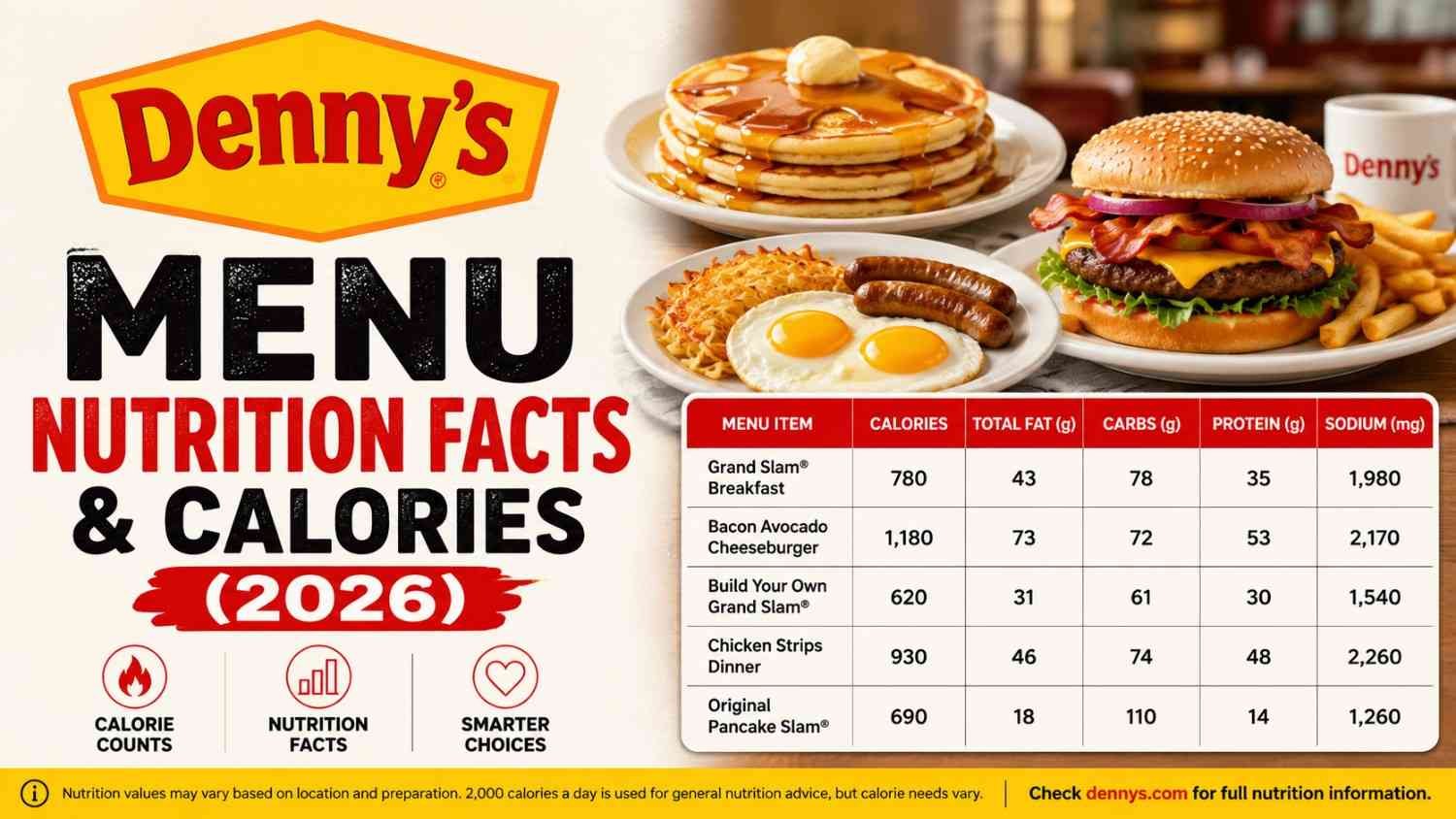
I used to think Denny’s was a “safe” choice. Open 24 hours, familiar menu, nothing weird on it. Then I actually sat down and pulled the Denny’s Menu Nutrition Facts for the things I’d been ordering for years, and honestly, a few numbers made me put my fork down for a second.
This isn’t a generic “eat the salad” article. It’s a breakdown of what’s actually in the food, where the real damage hides, and how to order at Denny’s without walking out feeling like you swallowed a brick.
Table of Contents
Why Denny’s Nutrition Numbers Surprise People
Most people judge a diner meal by how full they feel walking out, not by what’s on the nutrition label. That’s normal — nobody brings a calculator to brunch. But Denny’s portions are built for “diner hungry,” not “average adult,” and a few menu items pack more in one plate than most people eat in an entire day.
Here’s the part that actually surprised me: calories aren’t even the biggest issue at Denny’s. Sodium is. A lot of the platters land in a strange spot where the calorie count looks fine on paper, but the sodium is already past what you’d want for the whole day, before your coffee creamer and syrup even get added. I’ll get into specific numbers below, but keep that idea in your back pocket as you read — it changes how you should actually order.
Breakfast: Where the Calorie Bombs Hide
Breakfast is Denny’s bread and butter (literally), so this is where most people need the clearest picture.
The Slams are the classic Denny’s move — eggs, meat, a starch, and a bread choice bundled together. The Original Grand Slam (egg choice not included) comes in around 700 calories before you’ve picked your egg style or bread. Add two eggs and toast and you’re easily in the 950–1,000+ range. The Moons Over My Hammy with hash browns lands around 980 calories, and the Lumberjack Slam with hash browns is close to 990 calories — and that’s before bread.
Omelettes are sneaky. People assume eggs equal “healthy,” but the Ultimate Omelette with hash browns runs about 830 calories, and the Philly Cheesesteak Omelette with hash browns can hit 1,170 calories. A lot of beginners make this mistake — they pick the omelette thinking it’s the lighter option, then add hash browns and cheese and end up eating more than the pancake platter next to them.
Pancakes and French toast are deceptively heavy once toppings get involved. A basic buttermilk pancake order without toppings is around 223 calories for three pieces, which is reasonable. But the moment you add a “stuffed” version — Cinnamon Roll Pancakes with icing, for example, run past 1,000 calories for the full breakfast — the math changes fast. Syrup alone adds roughly 140+ calories for a typical 3-tablespoon pour, and most people use more than that without thinking about it.
If you want a lighter breakfast: the Fit Slam comes in around 450 calories, and a Veggie Omelette made with egg substitute and no bread or potato sits in the 330–350 calorie range. Those numbers actually hold up.
Lunch & Dinner: The Sandwiches and Skillets Add Up Fast
This is where I noticed the biggest gap between “looks reasonable” and “actually is reasonable.”
Sandwiches at Denny’s are not light. The Cali Club Sandwich comes in around 1,100 calories on its own — no fries, no side, just the sandwich. The Double Cheeseburger is similar territory at roughly 1,120 calories, and the Bourbon Bacon Burger pushes past 1,000 calories as well. These aren’t outliers; they’re closer to the norm for the sandwich and burger section of the menu.
Skillets have a wide range, which actually works in your favor if you pick carefully. The Fit Fare Veggie Skillet sits around 340 calories — genuinely one of the better dinner choices on the whole menu. Compare that to the Meat Lover’s Skillet with two eggs, which lands around 1,260 calories, or the Crazy Spicy Skillet at roughly 1,020 calories, and you can see how much the protein and cheese combinations matter.
Dinner plates that skip the heavy sauces tend to do better. Grilled Chicken Dinner without sides or bread comes in around 200 calories. Grilled Tilapia Dinner is roughly 466 calories. Compare that to the Slow-Cooked Pot Roast Dinner, which is closer to 1,390 calories once you account for the full plate — one of the heaviest dinner items on the menu.
The Side Dishes Nobody Thinks About
This is the part people skip, and it’s a mistake. Sides quietly add 200–800 calories without anyone noticing, because they don’t feel like “the meal.”
- Hash browns (plain): around 210 calories for a regular side order, but the Cheddar Cheese version jumps to roughly 300, and Loaded versions go higher still.
- French fries: about 510 calories for a standard order — more than some of the lighter entrees on the menu.
- Onion rings: roughly 820 calories per order, which honestly shocked me the first time I checked.
- Bacon Cheddar Tots with sour cream: around 500 calories for 10 pieces.
- Dressings are a quiet calorie trap too. Ranch dressing runs about 370 calories per 3-ounce serving, and Caesar dressing is close to 430. The fat-free Italian dressing, by comparison, sits around 30 calories — a genuinely useful swap if you’re watching numbers.
One thing that surprised me testing this myself: ordering a “healthy” grilled entree and then adding a side of onion rings or regular fries can completely erase the benefit of the lighter main dish. The side often costs more calories than the protein it’s sitting next to.
Desserts and Shakes: The Real Heavy Hitters
If there’s one category where Denny’s doesn’t hide anything, it’s dessert — these items are openly indulgent, and the numbers reflect that.
- New York Style Cheesecake with strawberry topping: around 605 calories per slice.
- French Silk Pie: roughly 690 calories.
- Banana Split: about 760 calories.
- Milkshakes are the real outliers — a Cake Batter Milkshake comes in around 1,310 calories, and an Oreo Milkshake isn’t far behind at roughly 1,180 calories. That’s more calories in a drink than in most of the entrees on this list.
If dessert is part of the plan, my honest advice is to split it. A shared slice of cheesecake at 300 calories per person is a very different experience than a whole milkshake solo.
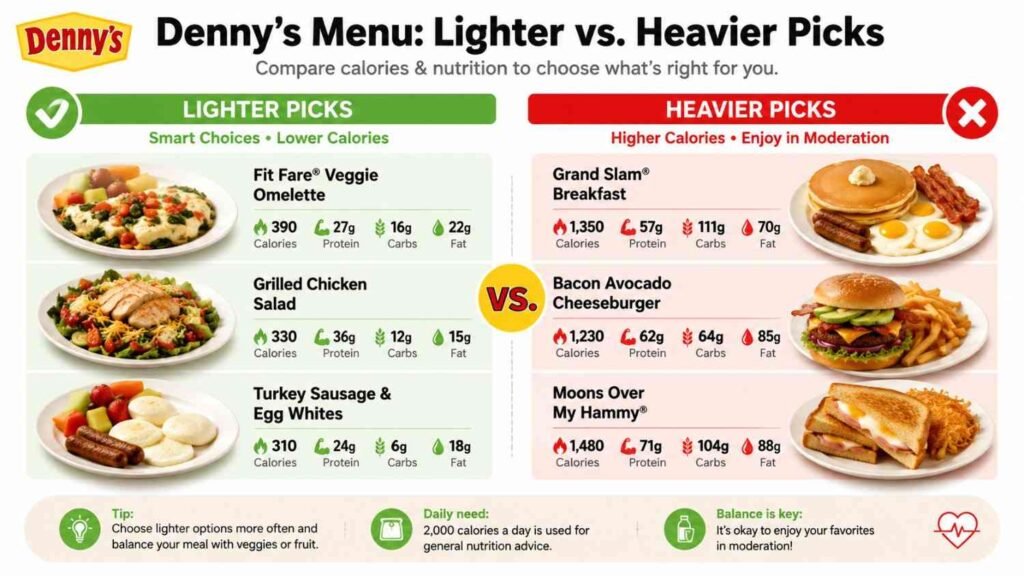
A Quick Comparison Table
| Category | Lighter Pick | Approx. Calories | Heavier Version | Approx. Calories |
|---|---|---|---|---|
| Breakfast Slam | Fit Slam | ~450 | Lumberjack Slam w/ hash browns | ~990 |
| Omelette | Veggie Omelette (egg substitute) | ~330 | Philly Cheesesteak Omelette w/ hash browns | ~1,170 |
| Sandwich | Grilled Chicken Dinner (no sides) | ~200 | Cali Club Sandwich | ~1,100 |
| Skillet | Fit Fare Veggie Skillet | ~340 | Meat Lover’s Skillet w/ 2 eggs | ~1,260 |
| Side | Side Salad / Broccoli | ~25–190 | Onion Rings | ~820 |
| Drink/Dessert | Unsweet Iced Tea | 0 | Cake Batter Milkshake | ~1,310 |
Sodium: The Number Most People Completely Ignore
I’ll say this plainly because nobody warned me: at a diner like Denny’s, sodium is the real story, not calories. The FDA recommends staying under 2,300 mg of sodium per day for the average adult. Several popular Denny’s breakfast platters get close to that number on their own — before coffee creamer, before a side, before anything you add at the table.
The categories that consistently run high on sodium are predictable once you know what to look for:
- Anything labeled “loaded”
- Items combining multiple proteins, sauces, and cheeses on one plate
- Anything served as a full “platter” or “skillet”
- Gravies and brown sauces, even in small servings
A high-sodium meal doesn’t always feel heavy the way a high-calorie meal does. That’s exactly why it’s easy to underestimate. The next-day bloating and that puffy, tired feeling after a big diner breakfast? That’s usually sodium, not the calorie count.
What Actually Works If You’re Watching Your Diet
Based on the numbers above, here’s what consistently holds up:
- Pick one heavy category per meal, not two. A skillet with cheese and a side of loaded tots is doubling up on the same problem. Pick the indulgent main OR the indulgent side, not both.
- Ask for hash browns plain, dressing on the side. This alone can save 100–300 calories without changing what you actually ordered.
- Split dessert or shakes. The numbers above make the case for themselves.
- Watch the “Build Your Own” options. They’re not automatically lighter — a Build Your Own Grand Slam with bacon, pancakes with margarine, and sausage links can match or exceed the pre-built Slams. The flexibility is the point, not a guarantee of fewer calories.
- Use egg whites or egg substitute if you’re sodium-conscious, not just calorie-conscious. It’s a smaller swap on calories than people expect, but it adds up across multiple eggs.
Common Mistakes I See People Make at Denny’s
- Assuming “salad” means low calorie. A Fried Chicken Strips Cobb Salad runs close to 930 calories — more than several burgers on the menu. The protein and dressing choice matter more than the word “salad” on the label.
- Treating sides as an afterthought. As covered above, a side can cost more than the entree.
- Skipping breakfast, then over-ordering at dinner. This is less about Denny’s specifically and more about how people eat there — a skipped breakfast often leads to ordering a 1,200-calorie dinner skillet “because I’m starving.”
- Not checking the senior menu, even if you’re not 55+. A lot of locations are flexible about who can order from it, and several senior portions are noticeably smaller versions of the regular plates — worth asking about if you actually want a smaller meal.
Read More: Denny’s Egg Menu Price, Calories & Nutrition Information (2026)
FAQ
Does Denny’s publish official nutrition information?
Yes. Denny’s provides nutrition details on its website and through in-store materials, and most locations can answer specific allergen or ingredient questions if you ask directly.
What’s the lowest-calorie breakfast at Denny’s?
Egg whites with a fruit side and turkey bacon, or the Fit Slam, are both reasonable choices in the 350–450 calorie range — without the heavy sodium load of the bigger platters.
Is Denny’s good for a low-sodium diet?
It can be, but it takes effort. Stick to grilled proteins, ask for sauces and gravies on the side, and avoid the “loaded” and multi-protein combo items, which tend to carry the most sodium.
Are the Denny’s “Fit Fare” items actually healthier?
Generally yes, based on the numbers — items like the Fit Fare Veggie Skillet and Fit Slam come in meaningfully lower in calories than their standard counterparts, without being bare-bones portions.
Can I customize a Slam to make it lighter?
Yes. Swapping in egg whites, choosing turkey bacon over regular bacon, and skipping the bread or hash browns can cut a Slam down by several hundred calories.